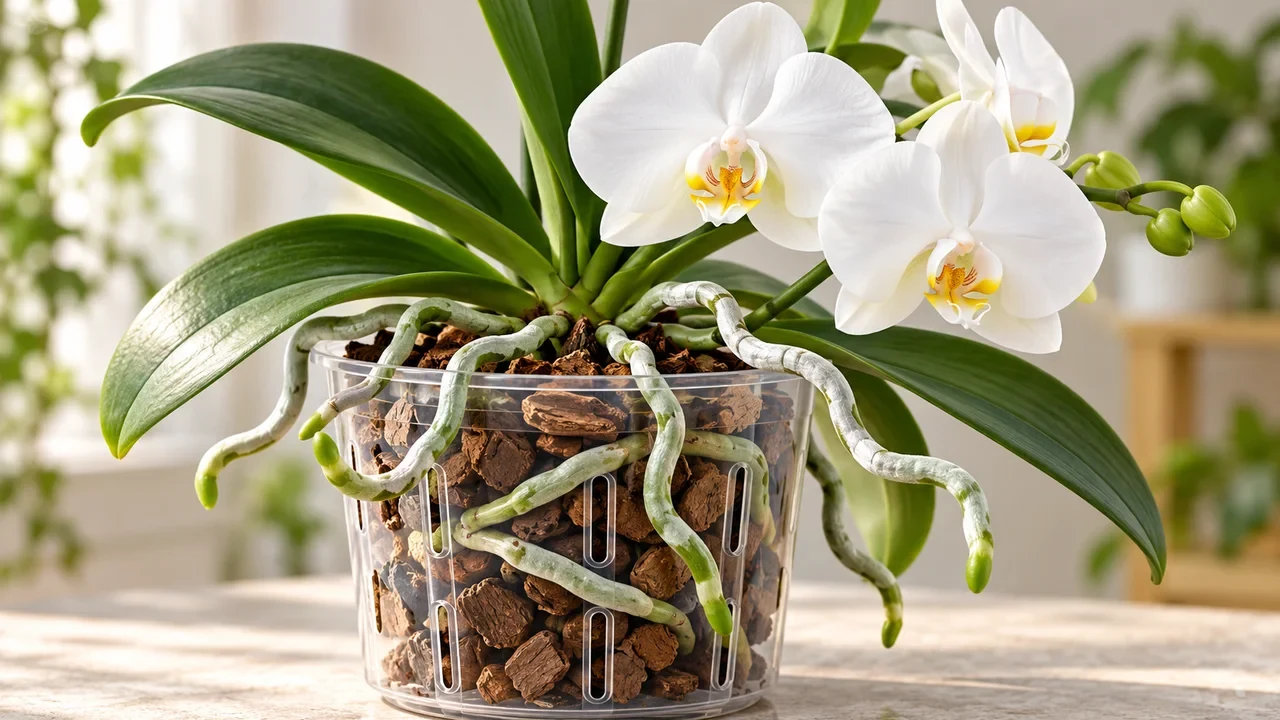
Illustrative editorial image generated with AI.
An orchid with roots reaching over the pot is not necessarily escaping a bad home. For a Phalaenopsis, the familiar moth orchid, exposed roots can be part of normal growth. “It lives on air” is nevertheless an incomplete care instruction: an aerial root still needs access to water, and the plant still needs suitable light and mineral nutrients.
This guide concerns commonly grown Phalaenopsis and the aerial roots of epiphytic orchids. Do not apply the same potting recipe to every orchid species; orchids also include plants with different growing habits.
Growing on a tree is not feeding on the tree
The RHS Phalaenopsis profile identifies this group as mainly epiphytic and recommends an open, bark-based growing medium. An epiphytic habit means using another plant as a place to grow, rather than requiring ordinary garden soil around the roots. It does not mean a houseplant can obtain everything it needs from a dry room.
Separate three questions when inspecting your orchid: is the plant receiving suitable light, can its roots obtain water without remaining waterlogged, and is its feeding appropriate? Buying fertiliser answers only the last question. It cannot replace a functioning root system.
What the silver root covering does
The pale covering on many exposed orchid roots is called velamen. The American Orchid Society's root explanation describes this absorbent outer layer and distinguishes it from the living inner root. A pale root is therefore not automatically dead.
Experiments reported by Zotz and Winkler in Oecologia found rapid uptake of solutions and retention of charged ions in velamen across the orchid species studied. That supports a role in collecting water and dissolved nutrients. It does not establish that household humidity alone supplies a potted orchid's water needs.
Inspect the whole root system before reaching for scissors
Look at exposed roots and, where visible, those inside the pot. Record texture, the state of the bark and whether water is standing in an outer container. Use a photograph to compare the same roots over time; this is more informative than deciding from a single green or silver patch.
| Observation | Sensible next step |
|---|---|
| Firm root outside the pot | Leave it intact and observe it; position alone is not evidence of damage. |
| Pale root with a firm surface | Check moisture and the rest of the plant before calling it dead. |
| Mushy or hollow root | Inspect for root deterioration and review the growing conditions. |
| Soft leaves and a wet pot | Check roots before adding more water; the symptom does not prove thirst. |
The American Orchid Society stresses texture when distinguishing healthy from dead roots. Do not repeatedly squeeze fragile growing tips as a routine test. For a broader inspection sequence, see our guide to recognising root rot.
Water the root zone, then let excess drain
Check the mix below the surface rather than watering because the same weekday has arrived. After watering, let surplus water leave the pot and empty the decorative outer container. Keep water out of the crown between the leaves. A quick spray over exposed roots is not a reliable substitute for checking the root zone.
The RHS growing guide recommends drainage and warns against both persistent wetness and excessive drying. It also advises an orchid bark mix rather than general-purpose or soil-based compost. Those distinctions matter more than making the roots look neatly hidden.
Repot for a reason, not to conceal roots
Before changing the pot, write down the problem you are trying to solve: deteriorated medium, an unstable plant, damaged roots or a container that no longer suits the root mass. A collection of healthy aerial roots is not, by itself, that problem. Do not force established exposed roots into dense soil simply to improve appearance.
Choose a pot and medium appropriate to the species and keep drainage unobstructed. Follow the fertiliser label and avoid increasing the dose to compensate for poor growth. The American Orchid Society's basic care guide links prolonged wet conditions to root loss and explains that plants without functioning roots cannot take up water and nutrients normally.
After a change, keep a short record of watering, how long the medium remains wet and any new root growth. Review those observations before making another adjustment. The aim is working roots and a stable growing environment, not a pot with every root tucked out of sight.